Rashtriya Krishi Vikas Yojana 2025: Overview
Rashtriya Krishi Vikas Yojana (RKVY) was started by the Government of India in 2007 to support farming and related sectors. This scheme helps improve agriculture by providing support to increase crop production and offering financial help to farmers. Each state can choose projects based on their local agricultural needs. By reading this article, you’ll get all the details about Rashtriya Krishi Vikas Yojana 2025, including its purpose, benefits, eligibility, required documents, and how to apply online.
What is Rashtriya Krishi Vikas Yojana?
RKVY was launched by the central government as part of the 11th and 12th Five Year Plans to bring overall growth in agriculture and related sectors. It gave states the freedom to pick agricultural projects that fit their region. During the 11th plan, ₹22,408.76 crore was released for 5,768 projects, and in the 12th plan, ₹3,148.44 crore was provided for 7,600 projects focused on crop development, horticulture, and mechanisation. Up to 2014-15, the scheme was fully funded by the Centre. Since 2015-16, funding is shared 60:40 between the Centre and states. Union Territories get 100% funding.
Also read: Kisan Vikas Patra Yojana
Purpose of Rashtriya Krishi Vikas Yojana
This scheme aims to develop agriculture and its related fields by encouraging agricultural entrepreneurship. It supports building better infrastructure for quality inputs, storage, and marketing facilities. The plan is made based on farmers’ needs to help increase their income and improve the economic conditions in the farming community.
A Message on Rashtriya Krishi Vikas Yojana by Ms. Chhavi Jha Joint Secretary (RKVY & PC), Ministry of Agriculture & Farmers Welfare pic.twitter.com/cED0TkEJmX — Agriculture INDIA (@AgriGoI) November 1, 2019
Main Details of Rashtriya Krishi Vikas Yojana 2025
| Scheme Name | Rashtriya Krishi Vikas Yojana |
|---|---|
| Launched By | Government of India |
| Beneficiaries | Farmers |
| Objective | Development of Agriculture Sector |
| Official Website | https://rkvy.nic.in/ |
| Year | 2025 |
Committees under Rashtriya Krishi Vikas Yojana
- State Level Project Screening Committee – Each state creates this committee to review project proposals. It is usually led by the Agriculture Production Commissioner or a nominated officer and members appointed by the State Chief Secretary.
- State Level Sanctioning Committee – led by the Chief Secretary, this committee approves projects after the screening committee’s review.
Must Read: Pradhan Mantri Kisan Sampada Yojana
Parts of Rashtriya Krishi Vikas Yojana
Regular RKVY-RAFTAAR (Infrastructure/Assets)
States can use 20% of 70% of the budget for pre-harvest infrastructure and 30% for post-harvest facilities. Projects are picked based on local needs.
RKVY-RAFTAAR Value Addition Projects
30% of the 70% state share can be used for value-added agricultural business projects to increase farmer incomes through related activities.
RKVY-RAFTAAR Flexi Funds
20% of the 70% state share is available for new activities in agriculture and allied sectors.
RKVY-RAFTAAR Special Sub-Scheme
This supports sub-schemes under national priorities like micro-irrigation and post-harvest management. Funds are reallocated if no special scheme is announced or if funds are less than 20% of the budget.
Agricultural Entrepreneurship Development
A separate budget supports skill training and financial help for agricultural entrepreneurs to start their businesses.
Promotion of Farmer Producer Organisations (FPOs)
FPOs with 500 or more farmers get subsidies and support under this scheme to grow and benefit members.
Benefits and Features of Rashtriya Krishi Vikas Yojana
- Started in 2007 to support growth in agriculture and allied sectors.
- States and Union Territories can choose development activities that suit them.
- Implemented during 11th and 12th Five Year Plans with a large budget and many projects.
- Funding pattern is 60:40 between Centre and states, 90:10 for northeast and hilly states, and 100% grants for Union Territories.
Check Also: Mission Karmayogi Yojana
Project Report Requirements
- States prepare detailed project reports (DPR) in formats provided by the Centre.
- Projects costing over ₹25 crore need third-party DPR checks.
- Projects should be new and not repeat existing ones.
- DPRs include yearly targets and are submitted to the State Level Project Screening Committee.
- After screening, reports go to the State Level Sanctioning Committee for approval.
Implementation of Rashtriya Krishi Vikas Yojana
- The Agriculture Department is the main agency at the Centre.
- State governments set up State Level Implementation Agencies.
- 2% of the state budget is used to run these agencies.
- They prepare State Agriculture Plans and Infrastructure Development Plans.
- District Agriculture Plans are also made by these agencies.
- They handle project execution, budgets, and monitoring.
- Utilization certificates are submitted through these agencies.
Funding and Release of Funds
- States get 50% of the annual allocation upfront for approved projects.
- If the project cost is less than the annual allocation, 50% of the project cost is released initially.
- The second installment is released after full use of the first, 60% expenditure, and submission of performance reports.
- Not submitting documents may cause funds to be given to other states.
- Accounts are strictly checked by main departments.
Administrative Expenses
- 2% of the budget can be used for admin costs like consultants, ongoing expenses, and staff salaries.
- No permanent jobs or vehicle purchases are allowed under this.
- Up to 5% of the budget can be used for DPR preparation.
Monitoring and Evaluation
- A web-based Management Information System helps with online project data submission.
- A dedicated team manages implementation and reviews projects regularly.
- Geo-tagging is done for all projects and assets.
- 25% of approved projects are monitored by third-party agencies at the state level.
- Monitoring uses 2% of the state budget.
- At the national level, monitoring is done by the Department of Agriculture Cooperation and Farmers Welfare.
Departments Covered under the Scheme
- Crop Husbandry
- Horticulture
- Animal Husbandry and Fisheries
- Dairy Development
- Agricultural Research and Education
- Forestry and Wildlife
- Plantation and Agricultural Marketing
- Food Storage and Warehousing
- Soil and Water Conservation
- Agricultural Financial Institutions
- Other Agricultural Programs and Cooperation
Eligibility and Fund Allocation
- All states can benefit from RKVY.
- The Centre funds 60% and states 40% of the scheme’s cost.
- For North Eastern and hill states, the Centre funds 90% while states provide 10%.
- For Union Territories, the Centre provides 100% of the funds.
Required Documents to Apply
- Aadhar Card
- Residence Proof
- Income Certificate
- Age Proof
- Passport Size Photo
- Mobile Number
- Email ID
RKVY Statistics
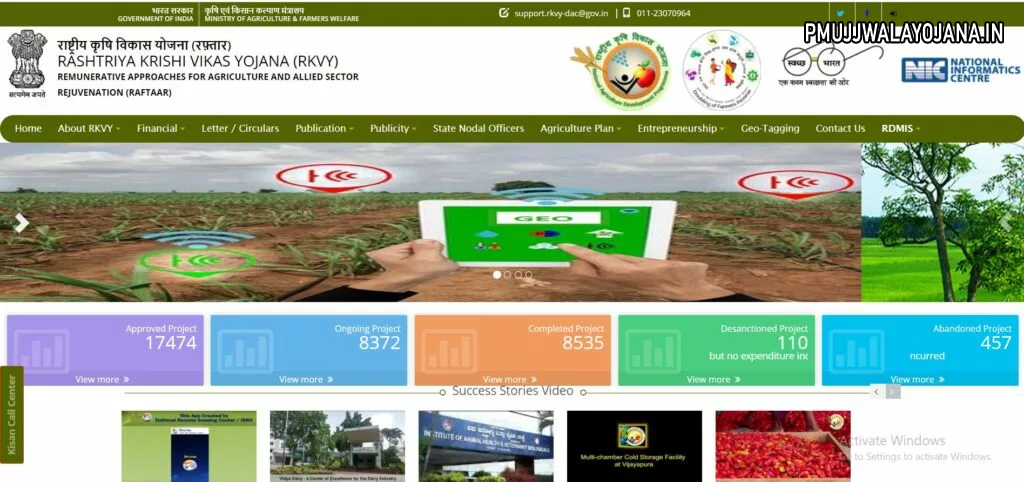
| Approved Projects | 17,474 |
|---|---|
| Ongoing Projects | 8,372 |
| Completed Projects | 8,535 |
| Discontinued Projects | 110 |
| Abandoned Projects | 457 |
How to Apply for Rashtriya Krishi Vikas Yojana 2025
- Go to the official RKVY website: https://rkvy.nic.in/
- On the homepage, click the ‘Apply Now’ option.
- A registration form will open; fill in all required details carefully.
- Upload all necessary documents as asked.
- Submit the form to complete your application.
Check List of State Nodal Officers
- Go to the RKVY official website.
- Click on ‘State Nodal Officer’ on the homepage.
- You will see a list of officers for each state.
How to View Contact Details
- Visit the official website.
- Click on ‘Contact Us’ on the homepage.
- A box will pop up showing contact information.